
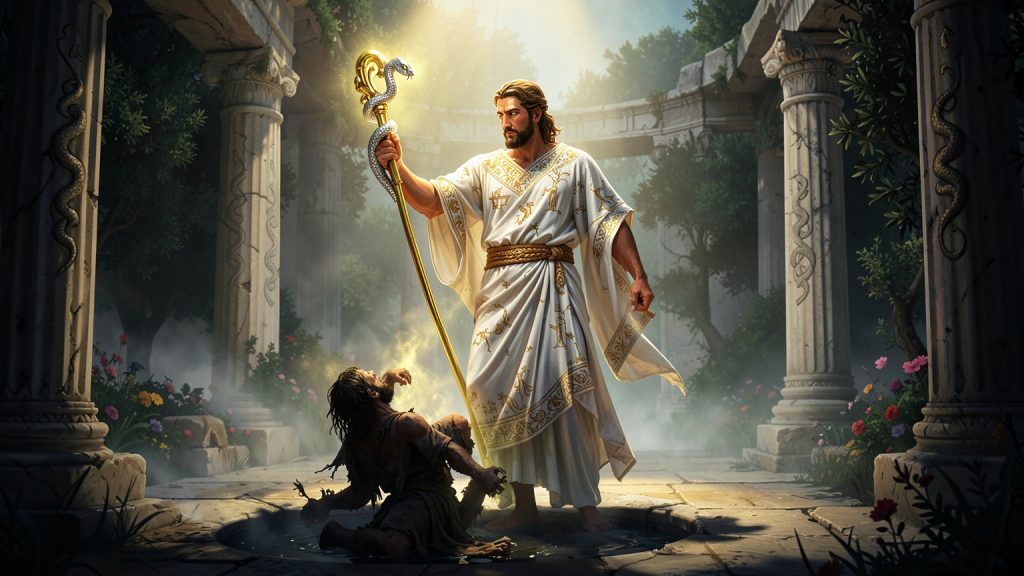
Asclepius was said to have crossed the line between life and death because he did something no mortal healer was meant to do: he brought the dead back to life. In the myth, this extraordinary act challenged the boundary that divided human existence from the realm of the gods and the underworld. For the Greeks, that boundary was not just physical. It was a sacred limit, and to overstep it was to invite divine anger. Asclepius’ story is therefore not only about medicine and healing, but also about the danger of healing too well.
The healer who became more than a mortal
Asclepius was known in Greek tradition as the great physician and god of healing. In most versions, he was the son of Apollo and the mortal woman Coronis, though local traditions could vary. Apollo had a special connection to medicine, prophecy, and purification, and Asclepius inherited that healing power. Yet he was not simply a divine child from the start. His story often emphasizes his training and his rise from gifted healer to figure so skilled that he seemed to rival the gods themselves.
Ancient Greeks worshipped Asclepius widely, especially at healing sanctuaries such as Epidaurus, where the sick would sleep in sacred space and seek cures through dreams, ritual, and divine signs. This cult shows that the myth was not merely a tale about the past. It helped explain why people believed healing could come from divine contact, discipline, and sacred knowledge. But the myth also warned that healing had limits.
The episode that made Zeus intervene
The key moment in Asclepius’ myth is his ability to restore the dead to life. According to the most familiar tradition, Asclepius learned so much about medicine that he could reverse death itself. Some accounts say he was taught by Chiron, the wise centaur associated with heroic education and healing knowledge. Others emphasize the role of Athena, who gave him the blood of the Gorgon Medusa. In a strikingly important detail, ancient myth often says that the blood from Medusa’s left side could kill, while the blood from the right side could heal or restore life. This double-edged gift fits the wider Greek interest in powers that can both save and destroy.
Asclepius then used this knowledge to bring the dead back among the living. Ancient sources do not preserve a single uniform list of whom he resurrected, and later retellings expanded the story in different ways. What matters in the myth is not the identity of every person revived, but the principle: Asclepius had crossed from healing illness into undoing mortality. That was the “line between life and death” that he was said to have crossed.
Zeus responded because this power threatened the cosmic order. If death could be cancelled at will, the boundary between gods and mortals would blur. Some traditions say Zeus struck Asclepius with a thunderbolt. Others soften the story slightly by saying Zeus acted after complaints from Hades, whose realm was being deprived of its dead. In either case, the message is the same: restoring life was not merely compassionate; it was a divine offense against the structure of the world.
Why the gods objected
To modern readers, punishing a healer for saving lives may seem harsh. In Greek myth, however, the issue was not medicine but cosmic balance. Mortality defined human existence. Mortals were not meant to escape death permanently, and even great heroes had to accept it. If a healer could undo death, then the dividing line between gods and humans would collapse.
This concern reflects a recurring Greek theme: excellence becomes dangerous when it exceeds human limits. The Greeks admired skill, intelligence, and usefulness, but they were also wary of hubris, the overstepping of proper bounds. Asclepius’ case is unusual because his transgression was motivated by healing, not pride in the ordinary sense. Yet the result was the same. He had acquired a power that belonged, in a full and lasting way, only to the gods.
In that sense, the myth is about more than punishment. It is a meditation on limits. Healing can delay suffering, ease pain, and even restore what seems lost. But it cannot erase the fundamental condition of being mortal. The story tells us that Asclepius became too successful for the world he lived in.
From dead mortal to immortal god
Asclepius’ story did not end with his death. In many versions, Zeus later restored him to divine status and placed him among the gods. This ending softens the tragedy and helps explain why Asclepius became an object of worship rather than a forgotten victim of divine violence. The god who was struck down for crossing the boundary of death was, in turn, granted a place beyond it.
This divine elevation also makes sense of his cult. A healer who had been punished for crossing the limit of mortality could become the perfect divine intermediary for people seeking relief from illness, pain, and uncertainty. His myth combined three powerful ideas:
- healing as sacred knowledge,
- death as a boundary no mortal should erase,
- and divine favor as the source of legitimate healing power.
Some later traditions also connected Asclepius with a family of healer figures, especially his sons Machaon and Podalirius, who appear in the Iliad as skilled physicians among the Greek forces at Troy. Their presence in epic literature shows that healing was already valued as a heroic art. But Asclepius goes beyond heroic medicine: he becomes the mythic figure through whom healing itself is elevated to a sacred, dangerous power.
Greek and Roman versions of the story
Greek authors preserved the core of this myth in different forms. Pindar famously refers to Asclepius’ rise and downfall, while later mythographers and poets tell fuller versions of how he was punished for reviving the dead. In the Roman world, Asclepius was identified with Aesculapius, and the cult continued strongly, especially in contexts of plague and public health. Roman writers generally inherited the Greek story, but they often framed it in ways that suited Roman religious practice and moral concerns.
It is important not to flatten these traditions into one fixed tale. Greek myth was not a single book with a single official version. It changed from place to place and author to author. The sanctuary at Epidaurus, for example, emphasized healing miracles and ritual experience, while literary accounts focused more on divine genealogy, punishment, and cosmic order. Roman retellings tended to stress the god’s usefulness in civic religion and medicine. The central idea remained constant, though: Asclepius stood at the edge of death and crossed over in a way no mortal should.
What the myth meant to ancient audiences
For ancient worshippers, the myth may have carried several meanings at once. It explained why Asclepius was powerful enough to heal serious illness. It also gave a sacred origin to the fear that healing has limits. Most importantly, it presented medicine as something more than technique. Healing was not just practical knowledge; it was a gift that touched the divine and therefore demanded respect.
The story also reveals a Greek unease with immortality. The gods themselves were immortal, but mortals were not meant to become so. Even when a mortal gains godlike skill, the myth insists on the restoration of order. In this way, Asclepius’ punishment is not simply an act of cruelty. It is the mythic reassertion of a boundary that defines the human condition.
Why the story still speaks to modern readers
Interpretively, Asclepius’ myth can be read as a story about the ethics of care. A healer’s desire is to save life, but what happens when saving life means challenging the structure of reality itself? The Greeks answered that question through myth rather than philosophy or science. Their answer was not to condemn healing, but to remind people that every act of healing takes place within limits.
That is why Asclepius remains such a compelling figure. He is not simply a god of medicine. He is the healer who crossed too far, the benefactor who became dangerous, and the divine patron whose power was born from transgression. His story captures a deep Greek insight: the line between life and death is sacred, and the one who crosses it does so at a terrible cost.