
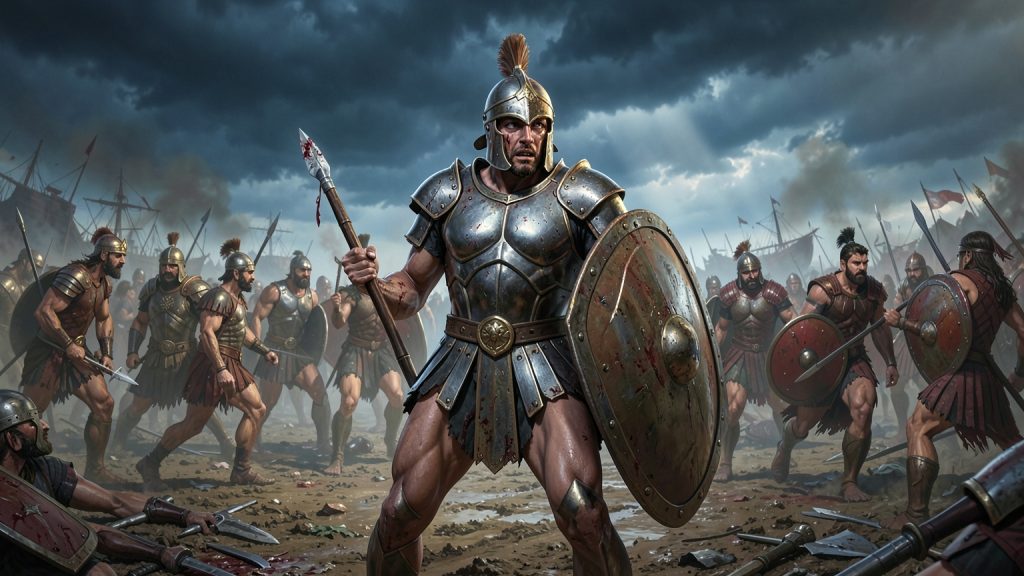
In the Iliad, Achilles is not the man with a vulnerable heel that later tradition imagines. Homer’s epic never says that his mother dipped him in the River Styx, nor does it describe any magical spot on his body that could be fatal. In the Iliad, Achilles is simply the greatest Greek warrior of the Trojan War: brilliant, swift, furious, and mortal. The famous “Achilles’ heel” belongs to later Greek and Roman storytelling, not to Homer’s poem.
Achilles in the Iliad: a hero, not a legend of invulnerability
The Iliad focuses on a short and devastating phase of the Trojan War, when Achilles withdraws from battle after a quarrel with Agamemnon. Because the poem is so concerned with Achilles’ anger, grief, and eventual return, it gives a rich portrait of his character but little interest in miraculous origins. Homer presents him as the son of the sea goddess Thetis and the mortal Peleus, which already places him between two worlds: divine in status, human in fate.
That human fate matters. Achilles is extraordinary, but he is not invincible. He can be wounded, he can suffer, and he can die. The poem repeatedly reminds the audience that even the greatest warrior is subject to death. This is one of the epic’s central themes: glory is brilliant, but it is brief.
The story the Iliad actually tells
The main action begins with a conflict over honor. Agamemnon, the commander of the Greek forces, takes Briseis from Achilles, humiliating him publicly. Achilles feels that his value as a warrior has been stripped away, so he refuses to fight. His withdrawal is not a side detail; it is the engine of the epic. Once Achilles stays out of battle, the Greeks begin to suffer badly at the hands of the Trojans.
As the fighting continues without him, the consequences become severe. The Trojans, led by Hector, push the Greeks back toward their ships. Patroclus, Achilles’ closest companion, eventually enters the battle wearing Achilles’ armor, hoping to save the Greeks and restore morale. This is one of the poem’s most tragic episodes. Patroclus is killed by Hector, and Achilles’ grief turns into a new and terrible rage.
Achilles then returns to battle, not because he has discovered a weakness in his body, but because loss has transformed his motives. He fights with overwhelming force, kills Hector, and drags the body around Patroclus’ tomb in a scene of raw grief and violence. The poem ends not with Achilles’ death, but with the meeting between Achilles and Priam, Hector’s father. In that encounter, Achilles briefly recognizes shared human suffering. The epic’s emotional climax is not a hidden heel, but a confrontation with mortality, mourning, and pity.
Where the weak-heel idea came from
The familiar story of Achilles’ single vulnerable point comes from later tradition, especially Roman-era versions of the myth. In those accounts, Thetis tries to make her infant son immortal by dipping him in the river Styx or by burning away his mortality with fire. Because she holds him by the heel, that part remains vulnerable.
This version is not found in Homer’s Iliad. It appears much later and is associated with authors such as Statius in the Achilleid, a Roman epic that is incomplete but influential in the history of the myth. Over time, the “heel” episode became the best-known explanation for Achilles’ downfall, especially in later European literature, art, and everyday speech. The phrase “Achilles’ heel” now means a hidden weakness, but that is a later cultural inheritance, not a detail from the original Greek epic.
Greek myth often changes from one author and period to another. That flexibility is part of the tradition. A hero may have one origin in Homer, another in a local cult story, and another in Roman retelling. For Achilles, the Homeric version and the later invulnerability story should be kept distinct.
The meaning of Achilles’ mortality
Even without the heel myth, Achilles remains a figure of extreme vulnerability. In the Iliad, his weakness is not physical but emotional and existential. His honor can be insulted. His loved ones can die. His choices can bring suffering to others and to himself. Most importantly, he is destined to die young if he returns to battle. The poem makes that fate part of the cost of glory.
This is one reason Achilles has remained such a powerful figure for readers. He is not merely the strongest warrior; he is a hero who knows that greatness and death are intertwined. In later Greek thought, this made him both admirable and tragic. His speed and beauty are matched by his instability and wrath. He embodies the heroic ideal, but he also exposes its price.
From a literary point of view, the absence of the heel myth in the Iliad is important. Homer does not reduce Achilles to a puzzle about one weak spot. Instead, he presents a fully human hero whose danger comes from anger, grief, pride, and fate. That gives the poem more depth than a simple tale of a protected body with one exposed flaw.
Myth, cult, and later reception
Achilles was not only a literary character. He was also revered in the Greek world as a heroic figure with cult significance in some places, especially around the Black Sea and in regions connected with his legendary travels and posthumous honor. These local traditions could vary widely. Some communities imagined him as a powerful presence after death; others emphasized his role as a model of warrior excellence.
Later Greek and Roman authors expanded his story in different directions. Some focused on his youth and education, others on his love life, and others on his death. The heel tradition fit well with a culture that enjoyed dramatic explanations for heroic downfall, especially in later moralizing or symbolic readings. In modern usage, the “Achilles’ heel” has become a universal metaphor for a single fatal flaw. That is a literary afterlife of the myth, not a historical fact and not a Homeric detail.
It is also worth distinguishing mythology from history. Achilles may have been inspired by Bronze Age heroic memory, but there is no historical evidence for an individual warrior exactly matching the epic figure. The Iliad is a poem about heroic tradition, not a record written by eyewitnesses. Its value lies in how it explores human conflict, not in providing biography.
So did Achilles have a weak heel in the Iliad?
No. In Homer’s Iliad, Achilles does not have a magical weak heel, and the poem never says that he is invulnerable except there. That idea belongs to later versions of the myth. In the Iliad, Achilles’ true vulnerability is deeper: he is mortal, emotionally intense, and bound to a fate in which glory and loss cannot be separated.
That is what makes him unforgettable. The Homeric Achilles is not weakened by a hidden flaw in his body, but by the same forces that shape all heroic lives in Greek myth: honor, anger, love, grief, and death. The later heel story is memorable, but the original epic is more powerful because it makes Achilles’ fragility part of the human condition itself.